Older documentation. Start with the current guides.
AI Integration
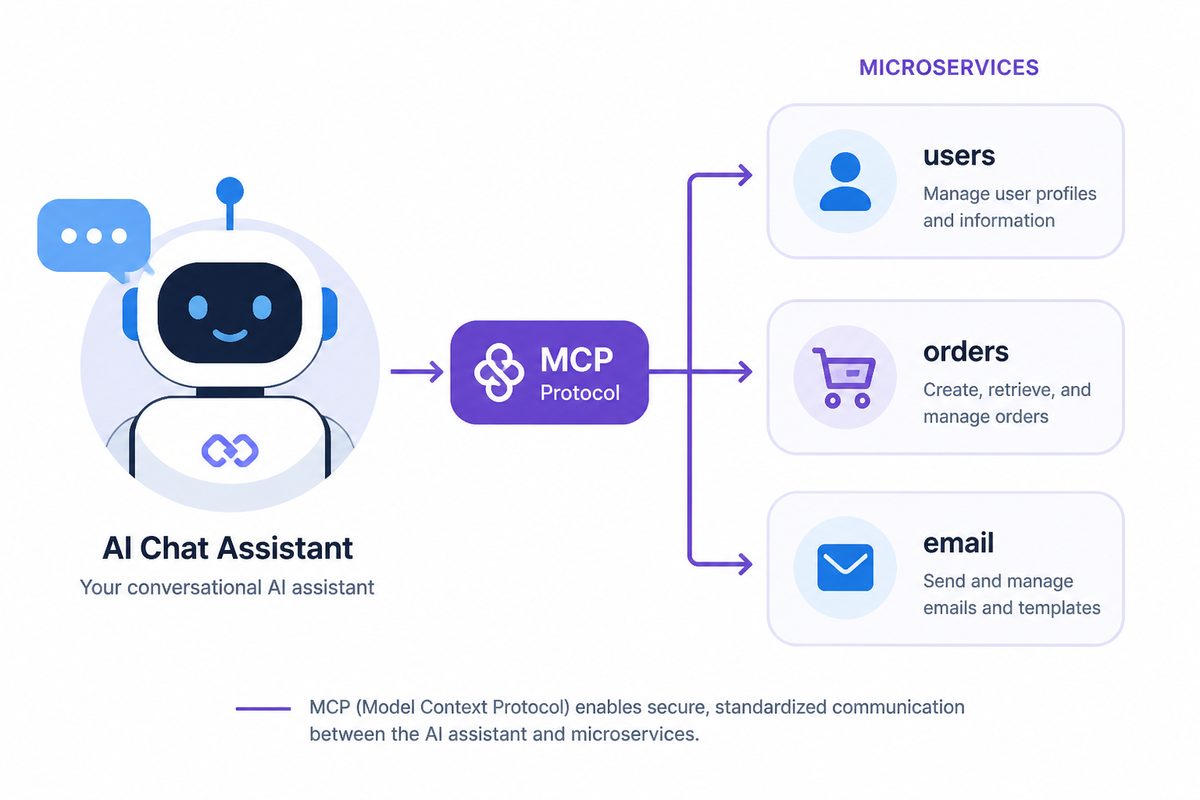
The Stack
Your Services           →  write Go handlers, register with the framework
    ↓
Registry                →  automatic service discovery (mDNS, Consul, etcd)
    ↓
Gateways                →  micro api (HTTP→RPC) / micro mcp (MCP tools)
    ↓
model.Tools                →  discovers services + executes RPCs programmatically
    ↓
model.Model                →  calls LLMs (Anthropic, OpenAI, Gemini, Atlas Cloud, ...)
    ↓
agent / flow / micro chat  →  agent-managed, event-driven, or interactive orchestration
Every layer is optional. You can use go-micro without AI. You can use the model package without MCP. But when you stack them, you get services that AI agents can discover and orchestrate automatically.
Layer by Layer
1. Services (your code)
Write normal Go handlers. Add doc comments for AI tool descriptions:
// CreateUser creates a new user account.
// @example {"name": "Alice", "email": "alice@example.com"}
func (h *Users) CreateUser(ctx context.Context, req *pb.CreateRequest, rsp *pb.CreateResponse) error {
    // your business logic
}
The doc comment becomes the tool description. The @example tag gives the LLM a usage hint. No AI-specific code in your handler.
2. Registry (service discovery)
Services register automatically. The registry is the source of truth for what’s running:
service := micro.NewService("users")
service.Handle(handler.New())
service.Run() // registers with the registry
Pluggable: mDNS (default, zero config), Consul, etcd, NATS.
3. MCP Gateway (services → tools)
The MCP gateway walks the registry and exposes every endpoint as a tool via the Model Context Protocol:
// One line to expose all services as AI tools
service := micro.NewService("myservice", mcp.WithMCP(":3001"))
Or run it standalone:
micro mcp serve              # stdio for Claude Code
micro mcp serve --address :3000  # HTTP for web agents
Any MCP-compatible agent (Claude Code, ChatGPT, custom agents) can discover and call your services.
4. model.Tools (discover + execute)
model.Tools turns registered services into LLM-callable tools — discovery plus RPC execution in one type:
tools := model.NewTools(service.Options().Registry)
discovered, _ := tools.Discover()  // []model.Tool from all registered services

// Wire execution into a model with one option:
m := model.New("anthropic", model.WithAPIKey(key), model.WithTools(tools))
This is what powers micro chat and the agent playground. You can use it directly in your own services to build agentic workflows.
5. model.Model (LLM providers)
The model package provides a pluggable interface for calling LLMs:
import (
    "go-micro.dev/v6/model"
    _ "go-micro.dev/v6/model/anthropic"
)

m := model.New("anthropic", model.WithAPIKey(key))
resp, _ := m.Generate(ctx, &model.Request{
    Prompt: "What users are in the system?",
    Tools:  discovered,  // from model.Tools
})
Provider adapters implement the same model interface. See the current provider list for supported models.
| Provider | Text | Image | Video |
|---|---|---|---|
| Anthropic | yes | ||
| OpenAI | yes | yes | |
| Google Gemini | yes | ||
| Atlas Cloud | yes | yes | yes |
| Groq | yes | ||
| Mistral | yes | ||
| Together AI | yes | ||
| MiniMax | yes | ||
| Ollama | yes |
6. micro chat (orchestration)
The CLI ties it all together — discovers services, builds the tool list, and lets you talk to your services:
ANTHROPIC_API_KEY=sk-ant-... micro chat --provider anthropic
> list all users
> send a welcome email to alice@example.com
> create an order for product-42
Conversations persist through the agent memory store. Use /new to start a separate conversation, /sessions to list them, and /resume ID to continue one.
7. micro flow (event-driven orchestration)
Subscribe to broker events and let an LLM orchestrate the response:
import "go-micro.dev/v6/flow"

f := flow.New("onboard",
    flow.Trigger("events.user.created"),
    flow.Prompt("New user: {{.Data}}. Send welcome email and create workspace."),
    flow.Provider("anthropic"),
    flow.APIKey(key),
)
f.Register(service.Options().Registry, service.Options().Broker, service.Client())
Or from the CLI:
micro flow run --trigger events.user.created \
  --prompt "New user: {{.Data}}. Send welcome email." \
  --provider anthropic

micro flow exec --prompt "List all users" --provider anthropic
8. micro api (HTTP gateway)
A standalone HTTP-to-RPC gateway for exposing services over HTTP without the full dashboard:
micro api                    # listen on :8080
micro api --address :3000    # custom port

# Call services through the gateway
curl -XPOST -d '{"name":"Alice"}' http://localhost:8080/greeter/Greeter.Hello
What You Don’t Need
- No agent framework — the building blocks compose; you don’t need a LangChain or CrewAI equivalent
- No special handler code — your services are normal Go handlers with doc comments
- No API key to use MCP — external agents bring their own models; your services just expose tools
- No vendor lock-in — every provider implements the same interface; swap with one import
Getting Started
Start with the Quick Start to develop services through
conversation. Follow Getting Started to create your
own Go agent and assign its service tools. The CLI development agent can generate
new services; a named micro.NewAgent uses the tools you explicitly configure.
See MCP, A2A, and the provider guide for integration details.